In a tightly managed studio, with cameras running and producers keeping a close eye on timing, viewers expected a familiar back-and-forth of talking points and measured disagreement. What emerged was sharper and less filtered. Within seconds, the moment had spilled far beyond the broadcast and into the wider digital landscape.
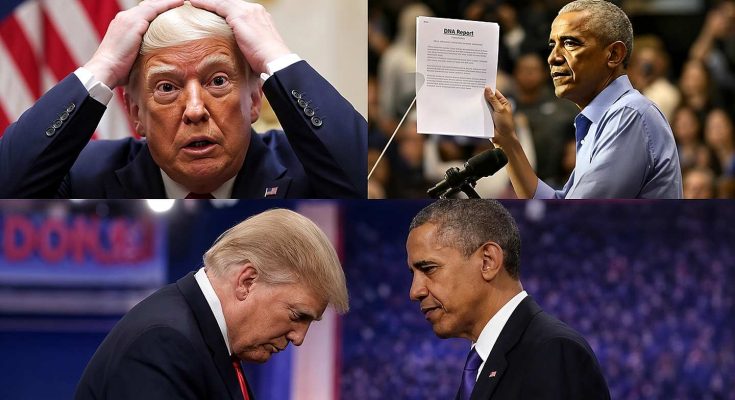
Donald Trump’s remarks about Barack Obama landed with a deliberate edge. On television, they registered as a direct critique of a former president. Online, they took on a larger life as a fragment of an ongoing political story, one that different audiences could read in sharply different ways depending on their existing views.
Supporters and Critics Read the Same Moment Differently
Trump’s supporters responded almost immediately, describing the remarks as candid and unrestrained. For them, the exchange offered a welcome contrast to what they see as overly polished political language, reinforcing the impression that he speaks without filters and is willing to confront opponents head-on.
Critics saw the same moment very differently. They argued that it was needlessly divisive and added fuel to a political climate already marked by tension and polarization.
From Studio Conversation to Viral Fragments
Within minutes of the interview airing, short clips were circulating across social media platforms. Segments were reposted, replayed, slowed down, and examined frame by frame. Pauses, emphasis, and facial expressions were all scrutinized for hidden meaning. A conversation that lasted only a few minutes in the studio became a collection of viral fragments, each carrying its own interpretation and emotional charge.
How Digital Distribution Changes Political Context
The episode points to a broader shift in how political discourse works. Television interviews once stood as self-contained events, watched in real time and understood within their full context. Today, those same interviews are absorbed into a continuous digital cycle in which context is often lost and isolated statements take on lives of their own.
This blend of live broadcasting and social media amplification has produced a political environment where attention is fragmented and meaning is constantly rebuilt by audiences. A single sentence can overshadow an entire discussion, and a brief reaction can shape public perception more strongly than hours of policy debate.
Analysts observing the exchange noted that its significance lay not only in what was said but in how quickly it was distributed and reinterpreted. Speed has become nearly as important as content. Within moments, commentary threads, opinion segments, and reaction videos were pushing the story in several directions at once, each reinforcing a different reading of the same event.
Performance and the Secondary Audience
The exchange also underscored how political communication has increasingly become a form of performance. Interviews are no longer simply exchanges of information between a host and a guest. They are often crafted with awareness of secondary audiences who will encounter them later through clips, highlights, and algorithm-driven feeds. Every statement speaks not only to the people watching live but also to the unseen audience that will see it in edited form.
In that context, Trump’s criticism of Obama functioned as more than a reference to past disagreements. It became a focal point for wider debates about leadership, legacy, and political identity. For some viewers, it reaffirmed long-held beliefs about accountability and political contrast. For others, it deepened concerns about escalating rhetoric and the erosion of traditional norms of political discourse.
What gave the moment its particular weight was not just its content but its amplification. The interview did not stay confined to a single platform or audience. It spread across multiple digital channels, with each one reshaping it slightly through commentary, headlines, and user interpretation. That layered distribution created a feedback loop in which reaction fueled visibility, and visibility generated still more reaction.
A Larger Pattern in Contemporary Politics
The interview fit into a larger pattern. Public figures now operate in an environment where any statement can become global within minutes, and the line between news, commentary, and entertainment is increasingly blurred. In such a system, maintaining control over a narrative is difficult, and meaning often shifts depending on who shares the content and how it is framed.
The broader implication is that political reality is now shaped well beyond legislative chambers and formal speeches. It is also forged in comment sections, short-form videos, and algorithm-driven feeds that tend to reward engagement over nuance. As a result, political identity is increasingly built from fragments rather than full narratives.
Ultimately, the interview served as a reminder of how quickly political communication can change once it leaves the controlled setting of traditional media. A structured conversation can become a global discussion in minutes, shaped as much by digital reaction as by the speaker’s original intent. Making sense of politics in this landscape requires more than listening to what is said. It also means paying attention to how and where those words are repeated, reframed, and reinterpreted.