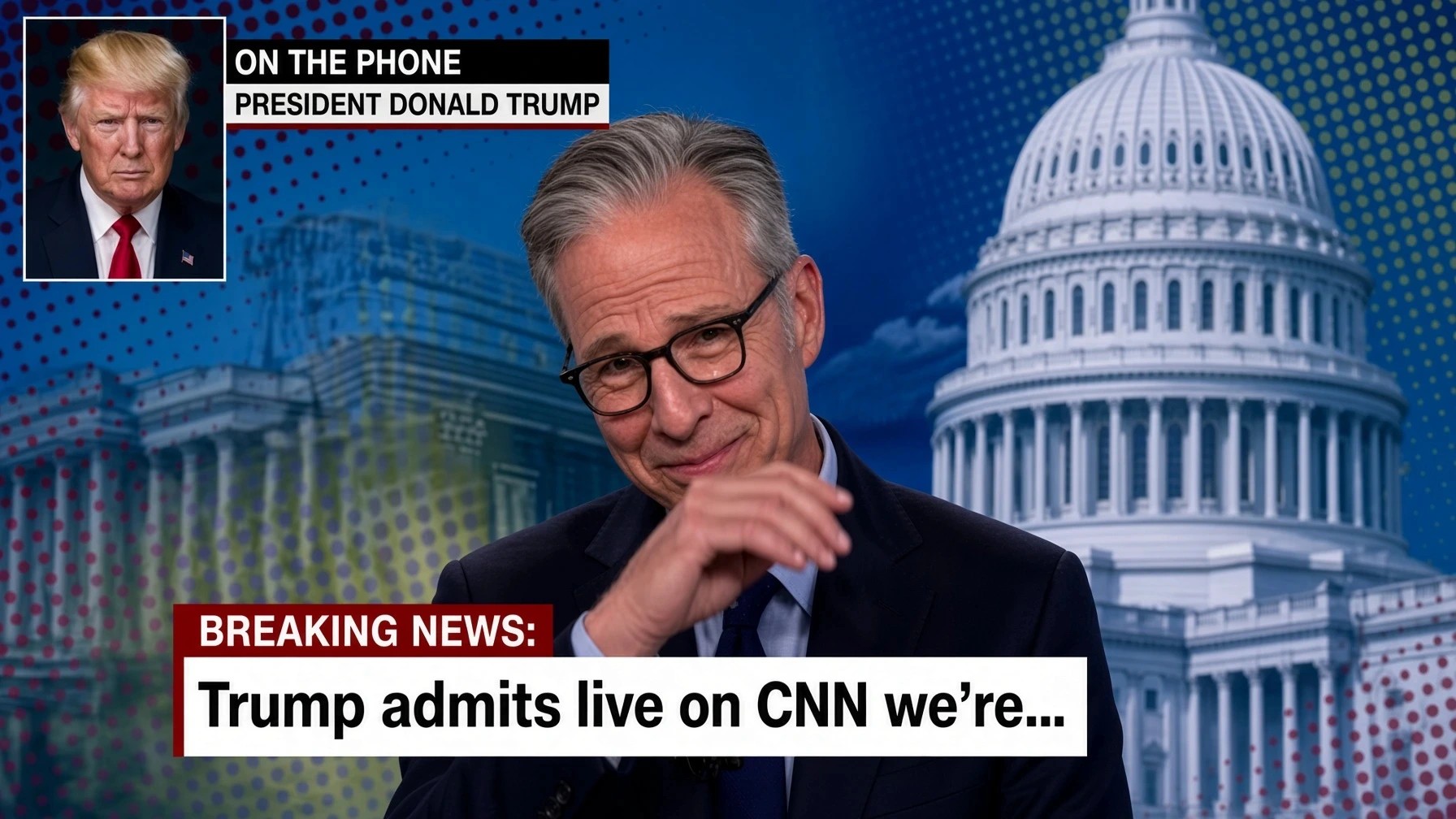
President Trump telephoned CNN on July 12, 2026, to publicly honor the recently deceased Senator Lindsey Graham, but concluded the brief interview with an unscripted remark suggesting the network should alter its editorial course.
Trump’s call to CNN’s flagship Sunday program, State of the Union, represented an unexpected departure from his sustained public criticism of the network. The appearance came in the wake of Graham’s sudden death, prompting the president to set aside years of rhetorical intensity to acknowledge the South Carolina Republican and longtime political associate.
Trump’s call to CNN’s flagship Sunday program, State of the Union, represented an unexpected departure from his sustained public criticism of the network. The appearance came in the wake of Graham’s sudden death, prompting the president to set aside years of rhetorical intensity to acknowledge the South Carolina Republican and longtime political associate.
Anchor Jake Tapper conducted the telephone interview and guided conversation toward Graham’s legislative record and political influence. When Tapper attempted to steer discussion toward pressing national issues, including escalating Iran tensions, Trump declined to elaborate. “I wanted to speak about my great friend,” Trump said, citing respect for Graham’s memory as his reason for the call.
What Happened
As the segment approached its conclusion, Tapper extended a standard invitation for Trump to return for a lengthier on-air discussion. Trump accepted the offer. Before the program could transition to a commercial break, however, Trump offered an assessment of CNN itself that was neither scripted nor anticipated by network producers. “We’re trying to have CNN go on a normal path,” Trump said. “And we will do that.”
Tapper responded with a defense of the network’s journalistic standards. “Well, I’m on a normal path right here, sir, and I appreciate your time,” Tapper said. Trump replied, “Good. You are,” and the call ended shortly thereafter.
The Reaction
The exchange circulated across media outlets and political circles within hours, drawing attention not for substantive policy claims but for its unexpectedness. Trump’s remark amounted to a rare, unfiltered acknowledgment on national television of a conviction he has articulated privately for years: that CNN operates in a manner he views as requiring correction.
The president did not specify what changes he intended or through what mechanisms such intervention might occur. He offered no critique of particular editorial decisions, personnel changes, or specific policies. His statement remained deliberately vague, leaving observers to interpret whether it constituted mere criticism or a signal of potential White House pressure on the network’s operations.
The timing of Trump’s comment carries additional weight given the corporate turbulence reshaping the media landscape. Warner Bros. Discovery, CNN’s parent company, is currently engaged in merger discussions that could restructure the entire organization. The Justice Department’s Antitrust Division approved in June a proposed $110 billion acquisition of Warner Bros. Discovery by Paramount Skydance—a transaction that would consolidate CNN and CBS News under unified ownership for the first time in their histories.
To address editorial independence concerns following consolidation, Paramount Skydance CEO David Ellison committed to establishing an editorial-oversight board comprising five members tasked with maintaining journalistic standards at both networks. Media analysts have raised questions about whether such a board, structurally connected to corporate ownership, could function as a genuine safeguard against external political pressure.
What This Means
Trump’s appearance on CNN itself—breaking years of public distance—demonstrates that his relationship with the network remains transactional and shaped by circumstance rather than principle. CNN’s willingness to air the interview reflects the network’s continued commitment to covering a president who has positioned media criticism as central to his political identity.
The phrase “normal path” functions as an interpretive opening. Trump’s political allies may cite it as evidence of his determination to restore balance to national news coverage, while critics may interpret it as an implicit pressure campaign directed at an independent news organization. The statement contains no explicit evidence of imminent censorship or direct White House control over CNN’s newsroom operations.
As media ownership structures continue consolidating and regulatory frameworks shift, Trump’s July comments serve as a marker of how newsrooms operate within complex networks of corporate interest, regulatory oversight, and political pressure. For CNN specifically, the coming months will test whether editorial independence can withstand pressure from multiple directions simultaneously—ownership consolidation, new governance oversight boards, and the explicit skepticism of a White House that has already declared its intention to shape the network’s future trajectory.