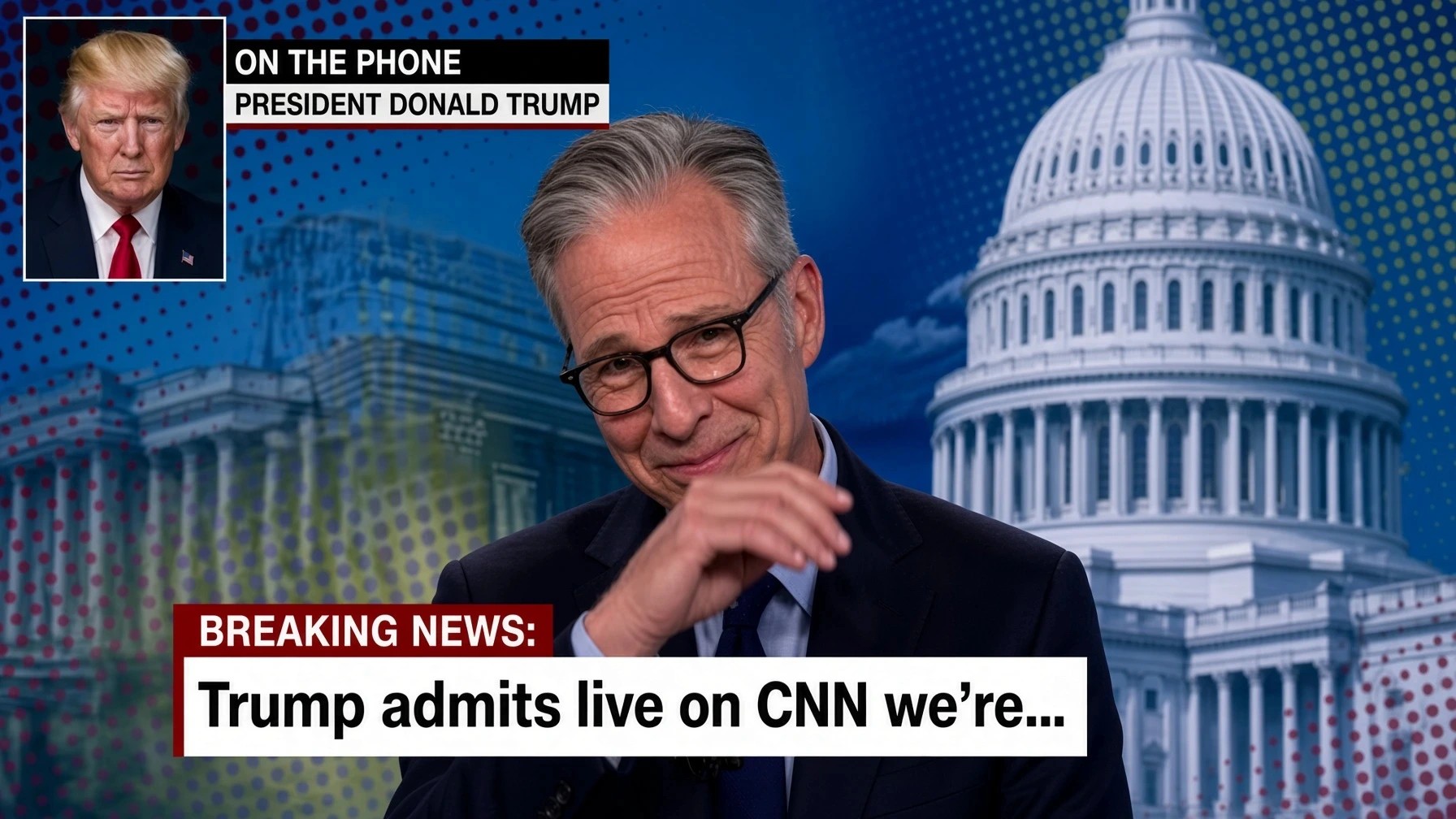
President Donald Trump called CNN’s flagship Sunday program, State of the Union, on July 12, 2026, to pay tribute to Senator Lindsey Graham, who had recently died. The brief telephone interview ended with an unplanned comment in which Trump suggested the network should alter its editorial direction.
The call was an unexpected move for a president who has spent years publicly attacking the network. Graham’s sudden death prompted Trump to set aside that combative tone and recognize the South Carolina Republican, a longtime political ally.
Anchor Jake Tapper conducted the interview and steered the conversation toward Graham’s legislative record and his political influence. When Tapper tried to move the discussion to pressing national issues, including escalating tensions with Iran, Trump declined to expand. “I wanted to speak about my great friend,” Trump said, explaining that he wanted to honor Graham’s memory.
What Happened
As the segment neared its end, Tapper extended a standard invitation for Trump to return for a longer on-air conversation, and Trump accepted. Before the program broke for a commercial, however, Trump offered an assessment of CNN that producers had not planned for. “We’re trying to have CNN go on a normal path,” Trump said. “And we will do that.”
Tapper pushed back by defending the network’s journalistic standards. “Well, I’m on a normal path right here, sir, and I appreciate your time,” Tapper said. Trump responded, “Good. You are,” and the call ended shortly afterward.
The Reaction
The exchange spread across news outlets and political circles within hours. Observers focused less on any policy claim than on how unusual the moment was. Trump’s remark was a rare, unfiltered statement on national television of a view he has expressed privately for years: that CNN needs correcting.
Trump did not say what changes he wanted or how they might come about. He did not criticize any specific editorial decision, personnel move, or policy. Because the statement stayed vague, observers were left to decide whether it amounted to ordinary criticism or a sign of possible White House pressure on the network’s operations.
The comment also landed amid major upheaval in the media industry. Warner Bros. Discovery, CNN’s parent company, is currently in merger discussions that could reshape the organization. In June, the Justice Department’s Antitrust Division approved a proposed $110 billion acquisition of Warner Bros. Discovery by Paramount Skydance. If completed, the deal would place CNN and CBS News under unified ownership for the first time in their histories.
To answer concerns about editorial independence after the merger, Paramount Skydance CEO David Ellison pledged to create an editorial-oversight board of five members to uphold journalistic standards at both networks. Media analysts have questioned whether a board connected to corporate ownership could serve as a real safeguard against outside political pressure.
What This Means
Trump’s on-air appearance at CNN, which broke with years of public distance, suggests that his relationship with the network is shaped more by circumstance than by consistent principle. CNN’s decision to air the call reflects its ongoing effort to cover a president who has made criticism of the media central to his political identity.
The phrase “normal path” is open to interpretation. Trump’s supporters may cite it as proof of his push to restore balance in national news coverage, while critics may read it as an implicit pressure campaign aimed at an independent news organization. The statement offers no explicit evidence of imminent censorship or direct White House control over CNN’s newsroom.
As media ownership continues to consolidate and regulatory rules shift, Trump’s July comments illustrate how newsrooms operate within overlapping networks of corporate interest, regulatory oversight, and political pressure. For CNN, the coming months will test whether editorial independence can hold up under ownership consolidation, new oversight structures, and the skepticism of a White House that has signaled its interest in shaping the network’s future.