Texas Republicans received an early voting projection on Wednesday suggesting their party holds a lead of nearly 100,000 modeled ballots, though the figures come from an independent analyst’s model rather than official state tallies.
What the Early Vote Model Shows
Election analyst E DataGuy published a graphic on October 21 tracking 731,837 early and mail ballots across the state. The model assigned 410,232 of those ballots to Republicans and 311,560 to Democrats, with 5,016 sorted separately.
That split produced an estimated Republican advantage of 98,672 ballots, which the analyst labeled the modeled firewall. The graphic described Republicans as the current leaders and projected final statewide turnout at 55 percent.
The analyst’s projected Republican vote share ranged from 53 to 59 percent, compared with 39 to 45 percent for Democrats. These are projections, not verified results or votes for either Senate candidate.
Caveats on the Data
Texas does not register voters by political party, so any partisan classification of early ballots is inherently uncertain. The screenshot did not include the model’s methodology, which limits independent evaluation of its assumptions.
An independent tracker, separately, identified 647,083 in-person ballots and 84,754 returned mail ballots. Early voting began October 19 and runs until Election Day on November 3, giving Texans several more opportunities to cast ballots.
Republican organizers have emphasized turnout in conservative communities, including suburban and rural counties. Even so, early figures offer a snapshot rather than a guarantee of either candidate’s eventual performance.
The Senate Matchup
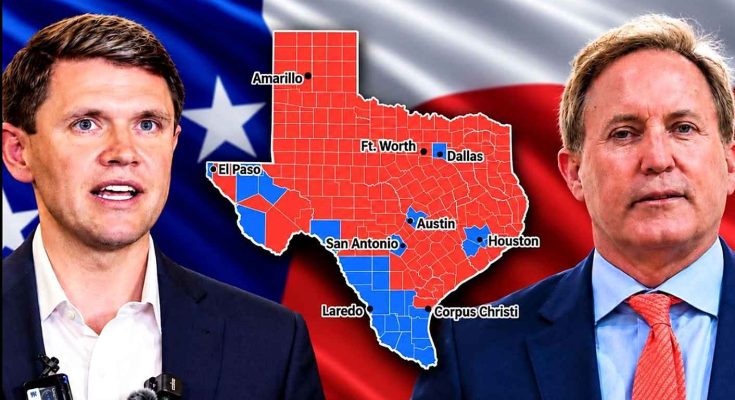
The statewide contest pits Republican Attorney General Ken Paxton against Democratic state Representative James Talarico. Both campaigns are courting voters concerned about the cost of living, immigration, and government priorities.
Talarico has centered his campaign on affordability and has criticized wealthy political donors who shape campaigns.
The Money Behind the Race
Associated Press reporting found that MAGA Inc., the super PAC aligned with President Trump’s political operation, has spent nearly $277 million since the beginning of September. The group transferred $200 million to No Going Back PAC and $25 million to Safety and Affordability PAC, affiliated groups that have financed advertising for Republican candidates in competitive races.
Federal filings showed MAGA Inc. held well over $164 million on October 14, down from nearly $416 million at the start of September. Those balances reflect different dates and should not be added together into a single total.
Trump said his political operation planned to spend well over $400 million by Election Day, covering advertising, voter contact, rallies, and other campaign activities. That figure is broader than the spending MAGA Inc. reported on its own. Trump-aligned advertising has included tens of millions of dollars supporting Paxton. Major MAGA Inc. donors include business figures Diane Hendricks, Stephen Schwarzman, and Steve Wynn.
Separately, the National Republican Congressional Committee reported raising $50 million in the third quarter. Its September fundraising reached $28.5 million, including a $14 million transfer from the Republican National Committee. According to its October announcement, the House committee entered October with $61 million available and reported raising $250 million across the election cycle through that reporting period. Those resources mainly support House contests rather than Paxton’s Senate campaign. The National Republican Senatorial Committee and outside groups run separate operations focused on Senate races.
Why Money Matters, and Its Limits
Republican fundraising will fund advertising, field organizing, and voter outreach during the final stretch. Spending later in a cycle, however, can buy fewer advertisements, because available airtime grows more expensive as Election Day approaches.
Democrats also hold significant resources, and individual Democratic candidates have posted strong fundraising totals. Talarico’s campaign has raised substantial sums, underscoring how intensely the Texas seat is contested.
For now, E DataGuy’s model places Republicans ahead in its estimated early ballot classifications. But financial strength cannot establish which candidate voters prefer or determine the outcome of the election.