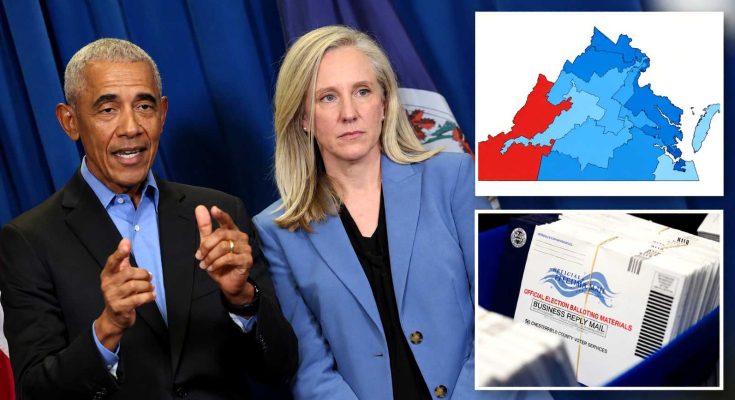
Early voting data from Virginia shows Republicans improving their modeled share compared with previous elections, even though Democrats hold a substantial advantage in the state’s ballot count so far. Election commentator E DataGuy published the update on October 21, reporting 822,770 ballots in his tracking system.
The Numbers Behind the Model
The analysis assigned 463,678 ballots to Democrats, or 56.36 percent of the total. Republicans received 353,513 modeled ballots, or 42.97 percent, while another 5,579 were classified as other. That gave Democrats a firewall of 110,165 ballots, the difference between the estimated partisan totals.
The gap is not an official election margin. Virginia does not register voters by political party, so the classifications are estimates rather than confirmed Democratic or Republican votes.
Where Republicans Gained Ground
Even with those caveats, the model’s internal comparisons offer Republicans several points to watch. Compared with the corresponding 2024 benchmark, Republicans increased their modeled share by 1.02 percentage points. Against the analyst’s 2022 comparison, their share rose by 1.70 points. The model lists 2024 Republican participation at 41.95 percent for reference.
Democrats moved in the opposite direction in the same graphic, declining 0.72 points against 2024 and 1.65 points against 2022. Taken together, the comparisons point to a narrower modeled partisan gap, though how much weight to give them depends on the underlying methodology.
The daily update also reported 23,092 additional Republican classified ballots since the previous day. Democratic classified ballots rose by 28,463, and the other category gained 299.
The most relevant finding for Republicans is the improvement measured against the analyst’s own historical partisan benchmarks. With the voting period still open, there is considerable room for additional ballots and shifts in estimated participation.
National Financial Resources
Republican organizers also enter the final weeks of the campaign with significant national financial resources. An Associated Press review estimated that several Republican-aligned political organizations held approximately 1 billion dollars. Comparable Democratic organizations controlled roughly 579 million dollars in the same assessment.
These totals combine separate groups and cannot be treated as money available to any single campaign.
MAGA Inc.
President Donald Trump’s allied super PAC, MAGA Inc., represents a particularly large share of those resources. According to campaign finance reporting, the group had nearly 416 million dollars available at the end of August. More recent filings showed it spent 277 million dollars from September through mid-October, supporting Republican candidates in several competitive congressional and Senate races. The same period also brought in another 25 million dollars.
Since its creation following Trump’s reelection, MAGA Inc. has reportedly raised 449 million dollars overall. Despite its aggressive spending, the group still reported substantial reserves by mid-October.
Trump has also said his broader political operation committed approximately 400 million dollars to midterm efforts. That figure includes advertising, voter contact, rallies, and election monitoring.
Outside political committees operate under different legal rules than candidate campaigns, including restrictions on certain types of coordination.
Congressional and Party Committees
Republican congressional committees have separately assembled resources for House and Senate campaigns. The National Republican Congressional Committee reported raising 50 million dollars in the third quarter and entered October with approximately 61 million dollars available, according to published fundraising coverage. In September, the committee had reported 89 million dollars in cash, which gave it an advantage over Democrats.
Those figures refer to different reporting dates and should not be added together. The Republican National Committee and Senate campaign organizations also maintain distinct fundraising and spending operations.
Campaign resources can fund television advertising, digital messaging, organizing, research, and direct voter contact. Republican groups have already deployed significant funds in competitive races outside Virginia. Money alone does not guarantee victory, particularly as advertising costs rise near Election Day. Democratic campaigns and aligned organizations also have considerable resources and established voter outreach operations.
What Comes Next
For Virginia Republicans, the early voting model’s improved historical comparison is a measurable development worth tracking. Strong national fundraising gives the party resources for the contest, but the final decision still rests with Virginia’s voters.