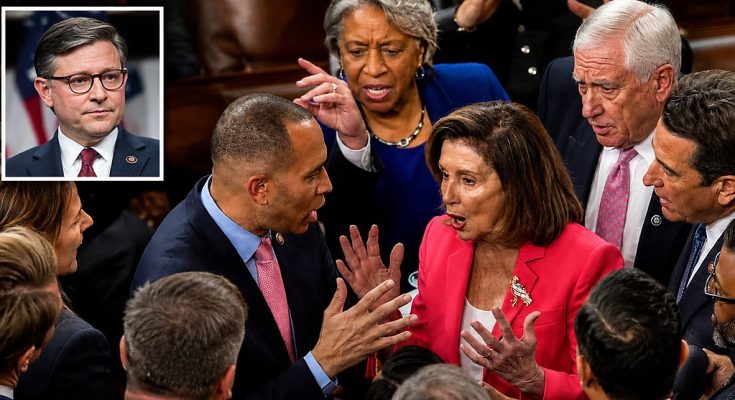
House Democrats were divided again on Wednesday when 33 members of their caucus joined Republicans to pass legislation that would limit federal funding for colleges that participate in boycotts of Israel. The House approved H.R. 4795, the Protect Economic and Academic Freedom Act of 2026, by a 237-169 margin. Thirty-three Democrats voted in favor, while 167 Democrats and two Republicans voted against.
A Party Split Along Familiar Lines
House Minority Leader Hakeem Jeffries voted no, putting him on the opposite side of dozens of Democrats who backed the effort to push back against campus boycotts. Former Speaker Nancy Pelosi and senior Democrat James Clyburn also opposed the bill, underscoring a public rift among Democrats over Israel policy.
Only two Republicans voted no: Thomas Massie of Kentucky and Warren Davidson of Ohio.
North Carolina Republican Virginia Foxx sponsored the bill, with New Jersey Democrat Josh Gottheimer serving as its Democratic co-sponsor. The measure would amend federal higher-education law to attach significant federal funding consequences to certain institutional commercial boycotts directed at Israel.
Progressives Push Back
Progressive Democrats responded with anger, arguing that the bill turns political disagreement with Israel into a reason for colleges to lose federal education dollars.
New York Democrat Jerry Nadler said he opposes the Boycott, Divestment and Sanctions movement, but argued that its supporters still have constitutional protections for political advocacy.
Michigan Democrat Rashida Tlaib was more pointed in her criticism. She accused lawmakers of stifling pro-Palestinian activism and shielding Israeli policies from scrutiny.
“This is an attack on free speech and academic freedom,” Tlaib said during floor debate before the final vote.
Tlaib also called Israel a “genocidal apartheid state,” a description that reflects the increasingly harsh language about Israel within the progressive wing of the Democratic Party.
Supporters Defend the Measure
Supporters rejected that characterization. They argue the bill targets institutional commercial discrimination, not students who protest or voice political views.
Johnson Makes the Case Ahead of November
The vote came as House Speaker Mike Johnson made a broader political argument ahead of the November midterm elections. In a Tuesday interview on CNBC, Johnson discussed President Donald Trump’s gathering of AI leaders, the tradeoff between AI progress and the concerns of everyday Americans, and whether Republicans could buck historical midterm trends.
Johnson suggested Democrats understand the need for the administration’s actions, even if they won’t say so publicly. “Now, this is a political argument they’re making. But let’s put all that debate aside because they’re never going to agree with us, they can’t, at least publicly,” he said.
He pointed to the economy as proof the strategy is working. “The economy, all the economic conditions are in place. As Scott Bessent said at the end of last year, 2025 is like setting the table. The feast and the banquet will be in the economy in 2026,” Johnson said.
Johnson credited the administration’s policies, including the Big, Beautiful Bill, for what he described as the largest tax cut for working families and the largest spending cut in U.S. history, totaling $1.6 trillion. He also cited the lowest violent crime rate in 126 years, the biggest decline in prescription drug prices in 60 years, and the most secure border in half a century. “Not a single illegal alien released into the country in 16 straight months,” he said.
He said small business incentives and pro-growth policies were performing as expected until the Iran conflict began. “And then the Iran conflict began. Now, we had to do it. The president’s convinced of that. We are. The world is a safer place because it was done,” Johnson said.
Energy Prices and the Election Stakes
Johnson tied the midterms directly to energy costs and border policy. He said Democrats had presided over $5 gasoline and pointed to former President Joe Biden and other party leaders who, he claimed, wanted to end fossil fuels. “Is that going to return those policies? Is that going to bring gas prices down? Of course not,” he said.
“They want to reopen the borders. We closed the borders. I mean, this is law and order. This is common sense versus crazy. That’s what’s on the ballot in 35 days. You have to keep the team in charge. That is putting the conditions in place for the economy to do better for everybody,” Johnson said.
He also laid out what he called the worst-case scenario if Democrats won control of either chamber. “Let me tell you the nightmare scenario. It’s not going to happen because I’m very bullish on the midterms. I am convinced my team, the Republicans, are going to keep the majority in the House and the Senate. I think we’re going to grow it,” Johnson said.
Johnson said the outcome will hinge on roughly 22 districts nationwide, and he expressed confidence Republicans could win them. “The nightmare scenario, heaven forbid, the Democrats take control of the House. They will turn every committee of Congress into an investigative body. They will do nothing all day, every day, every hour of the day, but go after the president, his family, his cabinet, you know, donors in the party, big figures in business and industry,” he argued.
He added that Democratic control would bring “lawfare on steroids” and would “roil the markets,” while empowering America’s adversaries. “They will be playing dangerous political games for their own benefit at the expense of the American people,” Johnson said.
A Warning About the Left
Johnson went further, arguing that the Democratic left is reshaping the party. “The DSA has told us what they’re all about. By the way, the insurgent left is consuming the Democrat Party. There will be no blue dog Democrats, no free market Democrats left after this cycle,” he said. He predicted that debates over marginal tax rates, inflation and foreign policy would give way to a larger fight over the country’s future.
“This will be a battle between whether or not we’re going to keep the republic or we’re going to break this thing down and go down this dark, dangerous road to Marxism. That is the energy, the excitement. The grassroots on the left is taking over the party,” Johnson said. “So that’s what’s at stake, common sense versus crazy. The Democratic socialists of America will drive the policy.”