OBAMA ROASTS TRUMP’S WHITE HOUSE MAKEOVER: THE SADDAM HUSSEIN COMPARISON THAT SET WASHINGTON ABLAZE
One cutting joke about gold decorations transformed a campaign rally into a national argument over presidential priorities, historic architecture, and the growing clash between Donald Trump and Barack Obama.
WASHINGTON, D.C. — October 29, 2026. A ballroom. A redesigned Rose Garden. A helicopter landing pad. And, according to Barack Obama, enough gold decoration to inspire one of the most startling comparisons of the American campaign season.
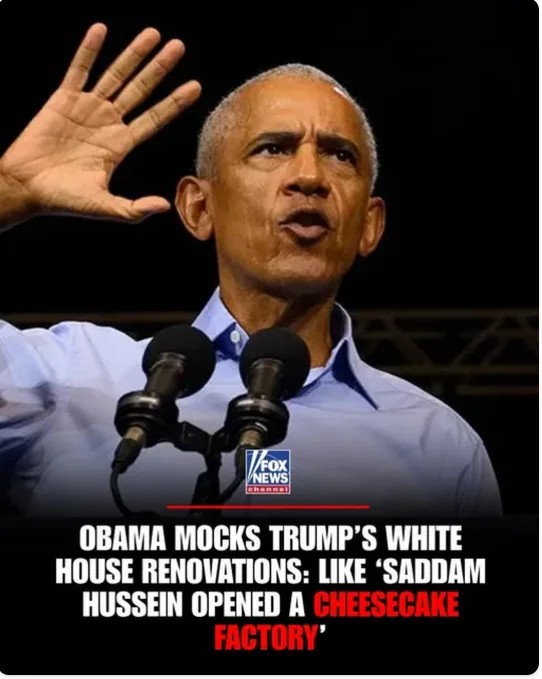
At a rally in Cleveland, Ohio, the former president took aim at Donald Trump’s White House renovation projects, turning a discussion about construction and interior design into a pointed political attack. His punchline invoked Saddam Hussein and a familiar American restaurant chain—a combination so unexpected that it quickly became the headline-grabbing moment of the event.
“He’s got the White House looking like Saddam Hussein opened a Cheesecake Factory,” Obama quipped, according to reporting by Fox News and TheWrap. The remark drew laughter and applause from the audience.
But beneath the joke lay a more consequential question: What should a president’s attention—and the country’s attention—be focused on when the cost of everyday life remains a central concern for voters?
Obama’s answer was unmistakable. He argued that Trump appeared more interested in transforming the nation’s most recognizable residence than in addressing the financial pressures facing American households.
The White House, in this telling, had become more than a backdrop for presidential meetings. It had become a symbol in a wider political dispute over priorities, public spending, leadership, and the image a president wants to leave behind.
And with the midterm elections approaching, the timing could hardly have been more politically charged.
THE JOKE THAT TURNED A RENOVATION INTO A POLITICAL STORY
Obama did not begin with the most provocative line. He built toward it.
Speaking at Cleveland Public Auditorium on October 24, he questioned whether Trump was devoting enough attention to the issues that matter most to ordinary Americans. He then suggested the president might be better suited to a home-improvement television program.
“I don’t know if you’ve noticed, but he seems very focused on home renovations,” Obama said. “He should be on HGTV.”
The line established the theme: a president preoccupied, in Obama’s characterization, with the appearance of his surroundings while voters worry about prices and household expenses.
Obama pointed to the administration’s ballroom project, changes to the Rose Garden, and a new helicopter landing area on the South Lawn. He also focused on the gold-colored decoration associated with Trump’s aesthetic preferences.
“What’s up with the gold?” he asked, before delivering the Saddam Hussein comparison.
The sequence mattered. Rather than treating each renovation as an isolated construction decision, Obama grouped them into a single political argument. The ballroom represented scale. The Rose Garden represented a change to a familiar historic setting. The helipad represented a visible alteration to the White House grounds. The gold became the punchline tying the entire critique together.
The result was a memorable moment that could travel far beyond the people inside the auditorium.
In the modern political arena, a speech may last 40 minutes, but a sentence can become the defining clip. A complicated argument about priorities can be compressed into a few seconds of video, replayed across television broadcasts, news websites, and social media.
That is what made the remark so potent as a piece of political communication. It was humorous, visually suggestive, and easy to repeat.
Yet its underlying meaning was more serious than its delivery suggested.
WHY INVOKE SADDAM HUSSEIN?
The comparison was designed to provoke. Saddam Hussein, Iraq’s former authoritarian ruler, remains associated in public memory with dictatorship, state power, and extravagant displays of authority. By invoking his name alongside the image of an American restaurant, Obama created a jarring contrast between authoritarian grandeur and commercial excess.
It was not an architectural report. It was political satire.
Obama was not offering a technical evaluation of the White House’s design, nor was he presenting evidence that the renovations served the same purposes as projects undertaken by Hussein’s regime. He was using a deliberately exaggerated image to criticize what he portrayed as an excessive focus on appearance.
That distinction is important.
Political humor frequently works by taking an object or behavior and pushing it toward absurdity. The audience does not need to accept every implication literally to understand the criticism. In this case, the joke invited listeners to see the gold decorations and construction projects as symbols of extravagance rather than simply as individual design choices.
Supporters could interpret the line as a sharp, effective way to challenge presidential priorities. Trump’s defenders could dismiss it as an insult intended to generate headlines rather than a serious argument about how the White House should be maintained.
Both reactions were predictable in an era when political figures increasingly communicate with audiences who already hold sharply different views of the people involved.
The question is not whether the joke was subtle. It was not. The question is what the joke reveals about the larger disagreement over the presidency—and whether a viral moment can keep public attention focused on the substantive issues it was meant to highlight.
THE BALLROOM AT THE CENTER OF THE CONTROVERSY
Of all the projects Obama mentioned, the proposed White House ballroom offers the clearest example of how a construction plan can become a political symbol.
A ballroom is not inherently a political statement. Large official events require space, and presidents regularly host visiting leaders, dignitaries, and other guests. Supporters of expanded event facilities can argue that a dedicated venue would provide practical benefits for official functions.
But scale, cost, design, and historical impact inevitably shape how such a project is received.
The White House is not an ordinary private residence. It is the home of the president, a workplace for senior officials, a venue for diplomatic events, and a historic symbol of the American government. Alterations to its grounds therefore carry significance beyond the preferences of the person occupying the Oval Office.
Obama seized on that symbolism by describing the ballroom as larger than the White House itself. That was part of his rally rhetoric, intended to underscore what he regarded as the project’s extraordinary scale. The claim should be understood in the context of his remarks rather than treated as a precise architectural measurement without further specification.
The wider debate involves questions that are more concrete.
What will the project cost? Who will pay? What approvals and preservation requirements apply? How will the design affect the historic complex? What practical needs is the new space intended to meet? And how should the public evaluate those needs against other national priorities?
Those questions cannot be settled by a punchline.
Nor can they be answered simply by dismissing every renovation as unnecessary. A responsible assessment requires reliable information about the project’s scope, funding, purpose, and effects.
Obama’s criticism placed the ballroom in a different frame: not merely as a building project, but as an illustration of what he believes the administration chooses to emphasize.
That framing is politically significant even if voters ultimately reach different conclusions about the project itself.
THE ROSE GARDEN: A FAMILIAR PLACE, A NEW ARGUMENT
The Rose Garden carries a special place in the visual history of the presidency.
For decades, its setting has appeared in televised speeches, official announcements, ceremonies, and meetings with foreign leaders. Its familiarity makes changes there especially visible to the public.
Trump’s administration altered the garden’s central lawn, replacing it with limestone paving while retaining roses around the perimeter, according to reporting on the renovation. The redesigned space can accommodate outdoor events and other official functions. Critics, however, have questioned the aesthetic changes and the transformation of a traditionally green setting.
Obama included the garden in his list of projects to reinforce his argument that the White House was being reshaped around Trump’s personal preferences.
But the competing interpretations deserve to be separated.
One interpretation sees the paving as a practical adaptation that makes the space more useful for gatherings. Another sees it as a loss of a familiar landscape and an example of a broader design philosophy that favors hard surfaces and formal spectacle.
Neither position, by itself, resolves the question of whether the changes were justified. That requires examining their practical benefits, cost, design, and impact on the historic property.
Still, the political power of the Rose Garden is obvious. People do not need to understand landscaping or preservation policy to recognize a place they have seen repeatedly on television.
A change to a familiar setting can therefore become a shorthand for a larger argument about tradition, taste, and presidential identity.
That is why the garden featured so prominently in Obama’s remarks. It was a recognizable example that helped turn an abstract debate about government priorities into something audiences could immediately picture.
GOLD DECORATION AND THE POLITICS OF PERSONAL TASTE
Then there was the gold.
Obama’s question—“What’s up with the gold?”—was brief, but it captured the central visual element of his attack.
Trump has long been associated publicly with gold-toned interiors and conspicuous decorative choices. His critics often interpret those preferences as evidence of a taste for grandeur. His supporters may view them as expressions of personal style, confidence, or a willingness to reject conventional design.
The same object can therefore communicate very different messages depending on the viewer.
For one audience, gold trim may suggest luxury and ceremony. For another, it may look excessive or dated. For a third, it may be little more than a matter of personal taste.
The political dispute emerges when the setting is the White House.
Unlike a private home or commercial property, the presidential residence belongs to a national institution with a history that extends far beyond any single administration. Even when a president has authority to make changes, the public may reasonably debate whether those changes respect the building’s historical character and serve a clear official purpose.
Obama’s joke transformed a design preference into a question of public responsibility. The implication was that presidential style becomes politically relevant when it appears to compete with the practical concerns of the people being governed.
That argument is not unique to Trump. Presidents have long been judged, fairly or otherwise, by the symbolism of their surroundings, their travel, their public appearances, and the way they present themselves.
The difference is that Trump’s highly recognizable aesthetic provides a particularly easy target for satire.
Gold becomes more than a color. It becomes a shorthand for a dispute over power, image, and what presidential grandeur should look like.
FROM DECORATION TO THE COST OF LIVING
Obama did not leave the argument at the level of interior design.
His broader point was that Trump’s attention to renovations contrasted with the economic concerns voters were raising. The former president linked the White House projects to questions about prices and affordability, suggesting that the administration’s priorities were out of step with household realities.
That was the real political purpose of the joke.
For families dealing with rent, mortgages, groceries, transportation, healthcare, and other bills, a renovation project can become a symbol of distance between government and everyday life. The contrast is especially sharp when the project is highly visible and associated with personal taste.
But the comparison also raises a question of evidence. The existence of a renovation does not, by itself, prove that a president has neglected economic policy. Governments routinely manage several responsibilities at once, and official construction projects may have practical purposes.
To evaluate Obama’s criticism fairly, voters would need to examine the administration’s economic record, the details of the construction plans, and the decisions affecting household costs. Those are separate questions, even if campaign rhetoric connects them.
The distinction matters because political communication often compresses several claims into one memorable image. A joke can make an argument accessible, but it cannot establish every factual premise behind it.
Obama’s line worked as a campaign message because it connected a visually striking subject to a concern many voters already recognize: whether those in power understand the financial pressures facing ordinary people.
Whether the comparison persuades anyone beyond the audience that already agrees with him is a different matter.
WHY CLEVELAND MATTERED
Obama delivered the remarks while campaigning in Ohio for Democratic Senate candidate Sherrod Brown and gubernatorial candidate Amy Acton. The event formed part of the Democrats’ effort to mobilize support ahead of the November 3 midterm elections, according to The Associated Press.
That context helps explain the intensity of the speech.
A former president appearing at a campaign rally is not merely offering commentary on current events. He is using his public profile to support candidates, define the stakes of an election, and encourage supporters to participate.
Obama’s criticism of Trump’s renovations served that purpose by linking a highly visible presidential project to a broader argument about economic priorities and accountability.
The choice of Ohio was also politically consequential. The state has featured prominently in national elections, and the contests involving Brown and Acton placed national party figures in a state-level campaign environment. Obama’s presence gave the candidates an opportunity to share a stage with a former president whose speeches can draw substantial media attention.
But campaign appearances should not be confused with independent assessments of the candidates’ records. Obama was there to support Democrats, and his remarks were shaped by that objective.
Republicans and Trump supporters have their own arguments about the economy, government spending, renovation projects, and the direction of the country. Those positions need to be evaluated on their merits rather than assumed to disappear because a memorable line receives widespread attention.
The rally was therefore both a political event and a media event: a gathering intended to mobilize voters that also produced a phrase capable of reaching a national audience.
A RIVALRY THAT NEEDS LITTLE INTRODUCTION
The exchange also drew attention because of the longstanding political contrast between Obama and Trump.
The two men represent different political coalitions and sharply different approaches to public communication. Their disagreements have extended across policy, presidential conduct, political identity, and the meaning of American leadership.
Obama’s latest remarks fit that broader pattern. Rather than limiting himself to a technical discussion of construction, he framed the renovations as an example of what he regards as misplaced presidential attention.
Trump’s supporters are unlikely to accept that interpretation automatically. They may argue that improvements to the White House are legitimate presidential responsibilities and that criticism of the décor is a distraction from policy disagreements.
That response would reflect a familiar feature of contemporary American politics: the same event can be interpreted through competing assumptions about the people involved.
For Obama’s audience, the joke offered a concise expression of frustration with Trump. For Trump’s defenders, it could serve as another example of a political opponent using ridicule instead of substantive debate.
Neither reaction should be mistaken for proof of the renovation projects’ value or failure.
The more useful question is what information would help the public assess the dispute: transparent cost estimates, a clear account of funding, documented project purposes, preservation considerations, and an examination of the administration’s wider policy decisions.
Humor may open the door to that discussion. It cannot replace it.
THE VIRAL MOMENT—AND WHAT IT CANNOT TELL US
The line was almost perfectly constructed for a digital news cycle.
It included two instantly recognizable political figures, an iconic building, an authoritarian historical reference, and an unexpected restaurant comparison. It was short enough to fit into a headline and vivid enough to be repeated without much explanation.
That combination helps explain why outlets quickly reported the remark and why it became a prominent part of coverage of the rally. TheWrap’s account and Fox 5 DC’s report describe the joke and the reaction it received.
Yet a viral moment is not the same as a political turning point.
A speech can dominate the news for a day without changing a single voter’s mind. A joke can energize supporters while irritating opponents. A headline can increase awareness of a policy dispute without giving readers enough information to evaluate it.
The number of times a phrase is shared is therefore an unreliable measure of its electoral impact.
To know whether the episode changed public opinion, researchers would need appropriate polling or other evidence, interpreted with care. To know whether it affected the election, one would need to distinguish its effects from the many other issues, events, and campaign messages competing for voters’ attention.
No such conclusion follows automatically from the joke’s popularity.
The phrase may be memorable. Its long-term political significance remains a separate question.
WHAT SHOULD THE PUBLIC ASK NEXT?
The controversy offers an opportunity to move beyond the punchline.
First, the public can ask what the renovation projects are intended to accomplish. If the ballroom is designed to host official events, what limitations of existing facilities is it meant to address? What are its projected costs, and how are those costs being funded?
Second, people can examine the physical changes to the White House grounds. What was altered, what was preserved, and what standards governed the work? How do the changes affect the site’s appearance, function, and historical character?
Third, the administration’s claims and its critics’ objections should be evaluated separately. A practical justification for a project does not automatically settle questions about its design or cost. Equally, a mocking comparison does not prove that a project lacks practical value.
Finally, the renovation debate should be placed alongside the broader policy issues raised during the campaign. Voters concerned about affordability can examine economic data and policy proposals rather than treating a construction project as a complete explanation for household financial pressures.
These questions are less instantly entertaining than Obama’s one-liner. They are also more useful for determining whether the projects serve a reasonable public purpose.
MORE THAN A FIGHT OVER GOLD
Obama’s Cleveland remarks turned the White House makeover into a symbol of a larger political argument.
His comparison involving Saddam Hussein and the Cheesecake Factory was designed to be provocative, and its immediate appeal was clear: it transformed gold decorations, a ballroom, and changes to the Rose Garden into one unforgettable image.
But the controversy is not ultimately about whether a particular color is attractive or whether a joke lands with an audience.
It is about the relationship between presidential image and public responsibility. It is about how the White House should balance practical needs with its historic character. And it is about whether highly visible decisions by the people in power reflect priorities that the public considers appropriate.
Obama offered one interpretation, delivered with the timing and sharpness of a seasoned political speaker. Trump’s defenders can offer another, arguing that renovations have legitimate purposes and that a president’s design choices should not be confused with the administration’s entire policy record.
The public is left with a choice about how to assess the competing claims—not by deciding which insult sounds most memorable, but by examining the evidence behind the projects and the policies they have come to represent.
May you like
Robert De Niro Blasts Trump at Voting Rights Rally, Urging Americans to…
Robert De Niro Launches Fierce Attack on Trump at Voting Rights Rally, Calls on Americans to Defend Their Ballots“HANDS OFF OUR VO…
★ “DIPLOMATIC DISASTER”… OBAMA ROASTS TRUMP!
★ “DIPLOMATIC DISASTER”… OBAMA ROASTS TRUMP!🚨 OBAMA UNLEASHES FURY ON TRUMP! “THESE ARE NOT SERIOUS PEOPLE” — FORMER PRESIDENT…
OBAMA: “A WEAKER US, A STRONGER IRAN”! THE TRUTH ABOUT TRUMP’S WAR…
OBAMA: “A WEAKER US, A STRONGER IRAN”! THE TRUTH ABOUT TRUMP’S WAR… Obama Warns of a “Weaker America, Stronger Iran”…
The joke may endure because it is vivid. The questions behind it are harder to dismiss.
And that is why a few words about gold, a ballroom, and a historic residence became more than a punchline: they opened another front in the continuing argument over what presidential power should look like—and what it should accomplish.
Other posts
🚨 EXPLOSIVE STUNNER: Nation on edge as President Trump reveals a terrifying new threat!…
🚨 30 MINUTES AGO: TRUMP HIT WITH A MAJOR GEOPOLITICAL BLOW! NATO IN TURMOIL AS HIS ANKARA…
Kamala Harris Tells John Kennedy “Sit Down, Boy” — His Reply Leaves America Speechless.
Trump Says Iran War Will End ‘Whenever I Want It to End’
CBS Host LOSES IT After Sen. Kennedy FACT CHECKS Her Trump LIES… THIS GOT BAD!…
Netanyahu’s Starkest Warning Yet — And the Political Gamble That Could Change Israel’s Fut…